

24 Words to Put Back in Common Usage
Is it Time to give Mothballed Language the Heimlich Maneuver?

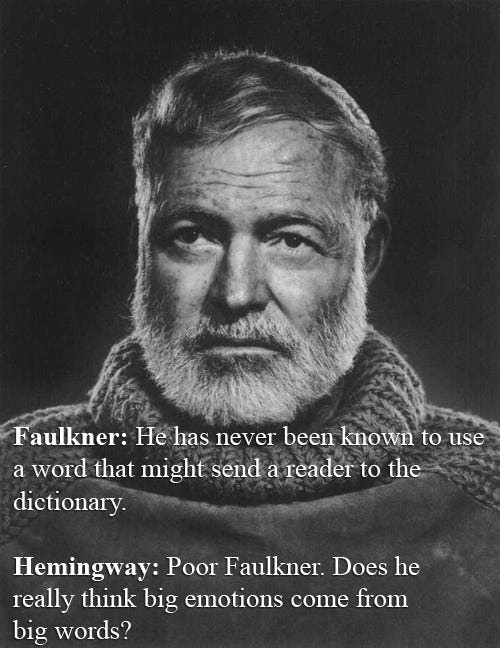
I can’t help it; I love both these fellas…
We all use language and some of us love it. The healthiest languages are nimble; they allow themselves to morph over time by responding to changing conditions. New technology, advancing science, and generational footprints, all leave their mark. And then there are the highjacked words. One effective social engineering tactic is to begin hammering the pliable steel of an old word into the sharp blade of a contgentious new culture direction, because they understand emotion-transference. It works for a while, but the original meaning is gone.
But what about those words that have simply gone out of fashion? They might still be in the dictionary but absent in popular usage. What a shame! Here are some of my favorite revival nominations in no particular order.
Forgive me punctuation and editing errors; these are cut and paste from an on-going document that I have so that I can locate the gems I find. As a caveat — it’s all in the public domain as far as I can tell; no plagirism here, folks.
Adamantine; adjective
Utterly unyielding or firm in attitude or opinion.
Ex: Her dedication to the pursuit of equality for the masses was adamantine, however.
Ex: “Briefly Noted: ‘Goddess of Anarchy,’” The New Yorker, February 5, 2018
Antigodlin; adjective, Southern and Western U.S.
lopsided or at an angle; out of alignment.
Bowdlerize; adjective
[bohd-luh-rahyz, boud-] verb (used with object), bowdlerized, bowdlerizing.
To expurgate; (a written work) by removing or modifying passages considered vulgar or objectionable.
Cantillate; verb
To chant; intone. Cantillate “to chant” derives from Late Latin cantillāre “to sing low, hum,” a verb formed from the stem cant- “sing” and the diminutive element -ill-. Cant- ultimately derives from the verb canere “to sing” and is the source of many words related to song, pronunciation, persuasion, and even light magic.
Ex: Standing in a tight circle the entire playing, coaching and support staff cantillate the words as if coming from the depths of their soul
Language in the Panama Canal Zone
Crepuscular; adjective
Of or like twilight; dim
Of certain insects, birds, and other animals) active at twilight or just before dawn
Deipnosophist; noun
A person who is an adept conversationalist at a meal.
Ex. Mr. MacPherson, a self-described “deipnosophist” (a fancy word for an adept dinner conversationalist), said the hearth is a good place to start for putting guests at ease. Rima Suqi, “Tending the Hearth,” New York Times, March 18, 2009
Euphonious; adjective
Pleasant in sound; agreeable to the ear; characterized by euphony : a sweet, euphonious voice.
Example: “The name Puah, less euphonious, is rarely used.”
Haimish; adjective
Homey; cozy and unpretentious.
The Yiddish adjective haimish (also spelled heimish) means “cozy, comfortable, unpretentious,” pretty much the same as English homey. Heimish comes from the Middle High German adjective heimisch (German heimisch), a compound of the Middle High German noun heim “home,” from Proto-Germanic haimaz, the same source as Old English hām (English home). The adjective suffix –ish comes from Proto-Germanic –iska-, source of English –ish. The Proto-Germanic suffix is related to the Greek suffix –iskos, used to form diminutive nouns such as neanískos “youth,” a diminutive of neanías “young man.” Heimish entered English in the mid-1950s.
The Broken Medical System From a Customer’s Point of View
Haphephobia; noun [ haf-uh-foh-bee-uh ]
An extreme fear or dislike of touching or being touched. It is a compound of the Ancient Greek noun haphḗ “a touch” and the combining form -phobia “fear,” from Ancient Greek phóbos. Haphḗ is a derivative of the verb háptein “to grasp, sense,” which is also the source of the adjective haptic “of or relating to touch.”
Inchoate; adjective
Just begun, and so not fully formed or developed.

Matilda’s dream of designing fashion bags is still in its inchoate stage. This prototype bag is problematic thus far.
Jacobin; noun
An extreme political radical (in the French Revolution) a member of a radical society or club of revolutionaries that promoted the Reign of Terror and other extreme measures, active chiefly from 1789 to 1794: so called from the Dominican convent in Paris, where they originally met. Today, an extreme radical, especially in politics.
Mizzle; verb (used with or without object)
To rain in fine drops; drizzle; mist.
Ex: By the time I left the cathedral it was already dark, mizzling, the kind of rain that looks like mist but drenches you in minutes.
Pat Barker, “Medusa,” The New Yorker, April 8, 2019
Mountebank; noun
A person who sells quack medicines, as from a platform in public places, attracting and influencing an audience by tricks, storytelling, etc. Any charlatan or quack.
Ex: “He is a wonderful man, the most extraordinary I ever saw, but there is more of the mountebank than of greatness in all this.”
The Greville Memoirs|Charles C. F. Greville
Ninnyhammer; noun
A fool or simpleton; ninny. Origin: 1585–95; ninny + hammer
Nomophobia; noun [ noh-muh-foh-bee-uh ]
Anxiety caused by being without access to a functioning mobile phone. It is an abbreviation of “no mobile phobia,” in which phobia refers to general worrying. While the nomophobia we’re featuring today was first recorded in English in the late 2000s, a different type of nomophobia appeared in English at the turn of the 19th century. The earlier nomophobia comes from Ancient Greek nómos, “law, management,” and means “fear of laws.”
Ex: “With their phones confiscated, the teens soon overcame their nomophobia by going for a walk and talking to each other face-to-face.”
Panglossian; adjective [ pan-glos-ee-uhn, -glaw-see-, pang- ]
Characterized by or given to extreme optimism, especially in the face of unrelieved hardship or adversity. Panglossian, “extremely optimistic, especially in the face of unrelieved hardship or adversity,” comes from Dr. Pangloss (Panglosse in French), an old, incurably optimistic tutor in Voltaire’s philosophical satire Candide. Pangloss comes from Greek panglossía “garrulousness, wordiness,” which also may suggest a certain amount of glibness. Candide, the name of the eponymous hero, comes from Latin candidus “bright, shining, pure, clean, good-natured, innocent,” perhaps also a comment on the hero’s naiveté. Panglossian entered English in the first half of the 19th century.
Ex: “Kraft sets to work making a case for Panglossian optimism while his marriage crumbles and his money problems worsen.” Rob Doyle, “For Ideologues in Silicon Valley, Everything Is Just Right,” New York Times, November 10, 2020
Philippic; noun
Any speech or discourse of bitter denunciation.
Ex: “Ms. Goldstein’s book is meticulously fair and disarmingly balanced, serving up historical commentary instead of a searing philippic.” Alexander Nazaryan, “Exorcising Ghosts From Classrooms,” New York Times, August 24, 2014
Poltroon; noun [ pol-troon ]
A wretched coward; craven. Or occationally as an adjective: marked by utter cowardice. 1520–30; earlier pultrowne, pultron, poultroone<Middle French poultron<Old Italian poltrone idler, coward, derivative of poltro foal <Vulgar Latin *pulliter, derivative of Latin pullus young animal; see foal
Ex: “But I can’t consent to pass for a fool; and still more not for a poltroon—You’ll excuse the little hint.”
Quiddity; noun
The quality that makes a thing what it is; the essential nature of a thing.
Ex: “… that gift for creating idioms may be a clue to the quiddity of his genius.” Adam Gopnik, “The Pleasure and Pain of Being Cole Porter,” The New Yorker, January 13, 2020
Scattergood; noun
A person who spends possessions or money extravagantly or wastefully; spendthrift.
Ex: “They are a pleasant couple, but it would be folly to bequeath the whole of my estate to a pair of such scattergoods.” “A Striking Legacy,” Truth, August 25, 1881
Slugabed; noun

Yes, that’s me as a slugabed in all my glory, circa 1964.
A person who lazily stays in bed long after the usual time for arising.
Ex: “I am not a slug-a-bed, Harriet.” Asobel’s voice was high and clear across the garden, “I get up as soon as my eyes pop open.” Barbara Ewing, The Trespass, 2002
Stonking; adjective, British informal
Used to emphasize something remarkable, exciting, or very large.
Ex: “a stonking 207 mph maximum speed”
Whinge; verb (used without object); British and Australian Informal.
To complain; whine.
Ex: “I wrote in my diary: ‘Here I am in Paris with dreams fulfilled and I whinge because my back hurts! But it bloody does.’” Patti Miller, Ransacking Paris, 2015
Zephyr; noun
A gentle, mild breeze.
Ex: “There was not even a zephyr stirring; the dead noonday heat had even stilled the songs of the birds…” Mark Twain, The Adventures of Tom Sawyer, 1876
So there you have it! These are a few of the words that I have fun with. Add them to your writing in those cases where it really works.
Did this article help you? If so share it with your word-loving friends.
To get a heads-up on other content as it comes out here at The Insomniac Workshop, hit the subscribe button and then comment about tour tool opinion.
More Mesmerizing Content
Power Lines Short story
The Broken Medical System From a Customer’s Point of View Article
A Robert Doisneau Photo Series Captures Viewer Emotion Photo article
My Problem With the Word Hate Podcast
Very cool post!